



How to Make a Small Exhibition Stand Effective
- 5 min read
Designing a small exhibition stand comes with one main challenge: making the space work without making it feel crowded. A small exhibition stand has limited space, so every element needs to serve a purpose. From the layout and branding to the way you display products and welcome visitors, small decisions can have a big impact on how your stand looks and performs.
When you have limited floor space, the goal is not to fit as many things as possible into the stand. The goal is to make the small exhibition stand space clear. Your stand needs to attract attention, communicate your message and give visitors enough room to interact with your team.
This is especially important when you are working with a small exhibition stand space, such as a 3m × 3m booth. With the right planning, even a compact stand can look professional, welcoming and memorable.
Here are practical ways to make the most of your small space without making it feel crowded.
1. Start With Your Exhibition Objectives
Before thinking about design, colours, furniture or graphics, decide what you want your stand to achieve. Do you want leads, product demonstrations, meetings, a launch or brand awareness? This affects how you use your exhibition stand space.
For example, a company launching a new product will need a different setup from a business that mainly wants to arrange meetings.
Your exhibition stand should be designed around the result you want to achieve. A stand built for lead generation needs to encourage conversations and attract visitors to your stand, while a product launch may need stronger product visibility and demonstration space. Defining this early helps you invest in the right layout, graphics and features rather than paying for elements that add little value.
The important point is that every item should support your objective. If something does not help attract, inform or engage visitors, consider removing them.
2. Plan Your Small Exhibition Stand Layout
A good exhibition stand layout should make movement feel natural. Visitors should be able to see into the stand, enter without hesitation and leave without walking around the counter or display.
Divide the space into simple zones: welcome, display, conversation and storage. These do not need to be equal in size. The welcome point may be a slim counter near one side, the main display can sit against the back wall, and a small standing table can support conversations without blocking the entrance.
You do not need a separate physical wall for each zone. The zones can be created through furniture, lighting, flooring and positioning. This is one of the simplest exhibition stand designing methods to maximise small exhibition stand space without adding more floor area.
3. Make Use of Vertical Space
The floor is limited, but the walls and upper areas can improve visibility.
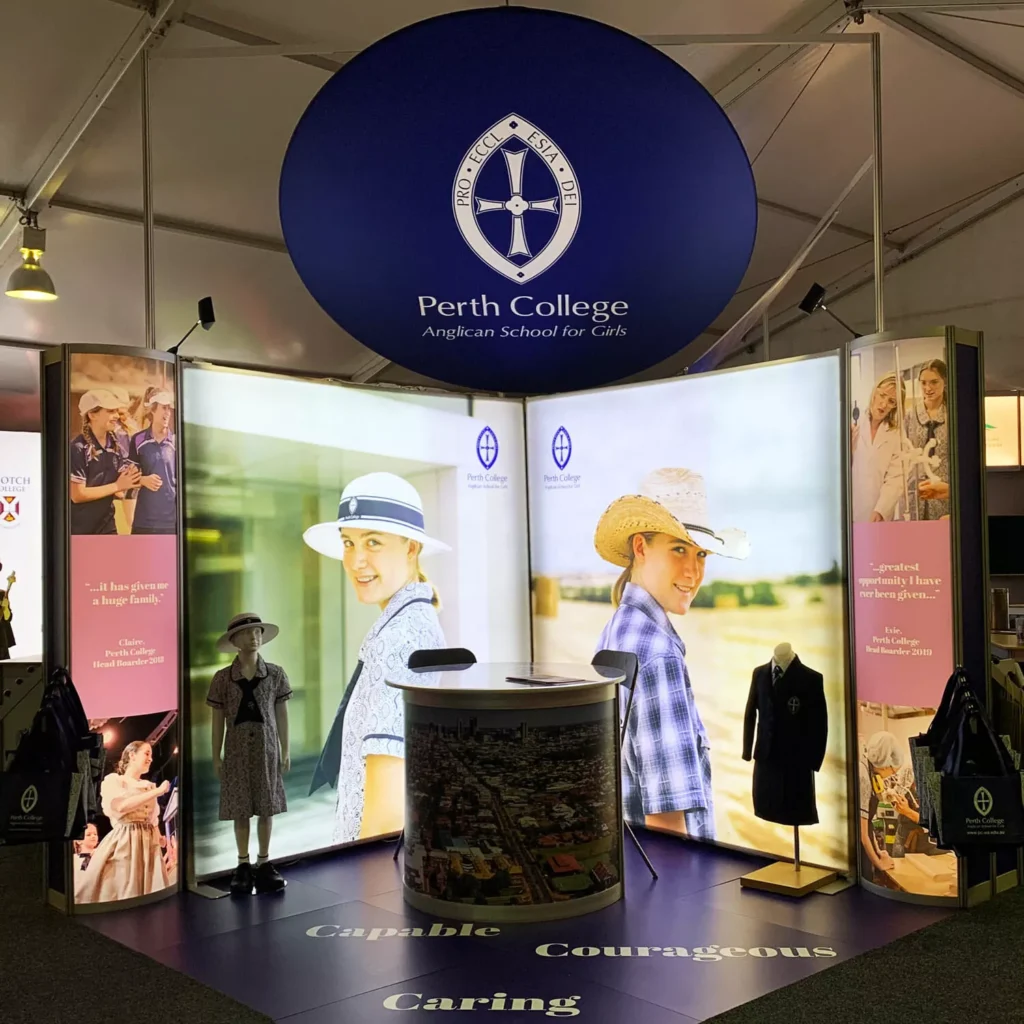
The height of your stand gives you valuable space for branding without taking away room for visitors or furniture. Depending on the exhibition organiser’s rules, use tall back walls, hanging elements or vertical display structures to increase visibility.
Your logo and main message should be easy to see from the aisle. This helps people locate you in a busy Australian exhibition hall and keeps your most important message above other things.
However, avoid filling the entire wall. Empty space can make your stand look more premium and helps important information stand out.
Visitors usually do not have time to read a large amount of text while walking around an exhibition. Keep the most important information at the level and distance where it can be understood quickly.
4. Choose Space-Saving Exhibition Furniture
Furniture and other exhibition essentials can take up more space than expected, especially in a compact booth. Large sofas, wide reception desks and additional essentials may look impressive in a large stand but can make a small stand difficult to use.
Choose exhibition furniture that supports the visitor journey rather than just consuming a large floor area.
For example:
- A reception counter can include hidden storage.
- A display counter can also work as a meeting point.
- A narrow high table can support short conversations.
- Stools can provide seating without taking as much visual space as large chairs.
- Built-in cabinets can hide brochures, bags and extra products.
The shape of the furniture also matters. Slim and simple designs usually work better than bulky pieces in compact spaces.
Keep furniture towards the back or sides where possible. You want visitors to be able to move naturally through the space rather than walk around obstacles.
5. Use Product Displays Strategically
A small stand should not attempt to showcase your entire product range. Select one hero product, a related group or one clear demonstration. Visitors are more likely to remember a focused display than a collection of products.
One of the simplest ways to avoid overcrowding is to build the stand around a single hero display. Position the most important product where it is clearly visible from the aisle, then use height, a plinth, a lit niche, or a simple label to give it visual priority.
If the product needs explanation, add a short benefit statement beside it and save technical detail for the conversation, brochure, or screen. The aim is to communicate the key message quickly without overwhelming visitors.
You can use vertical shelving to increase display capacity without taking up large valuable floor space. Digital screens can also be useful, particularly when showing products or services that cannot physically fit inside the stand.
6. Use Lighting to Make a Small Stand Stand Out
Good lighting can make a compact space feel brighter, more open and more attractive. It can also direct attention towards the areas you want visitors to notice.
Instead of lighting everything equally, use lighting with a purpose. For example, you could use:
- Spotlights to highlight a product
- Backlighting behind your main graphic
- LED screen and strips to emphasise architectural features
- Soft lighting around a meeting area
- Focused lighting on shelves or display cases
Backlit graphics can be particularly effective because they combine branding with illumination. Avoid using too many different colours of light. A simple and consistent lighting scheme usually looks more professional.
Also, check how the stand looks under the venue’s actual conditions. Selective accent lighting works great on compact stand spaces rather than adding light everywhere.
7. Make Your Graphics Work From a Distance
Your exhibition graphics need to work at two different distances. From the aisle, they should attract attention and communicate one main idea. At a close range, they need to provide useful information.
This means your main graphic should not be a large paragraph. Use a strong headline, a clear visual and your branding. Add one strong image or product visual, use high contrast and leave enough empty space around the message. Make sure your logo is visible, but do not let repeated logos replace useful communication.
Think about what someone walking past your stand might understand in three to five seconds.
Use strong contrast, readable fonts and a limited number of visual elements. Your graphics should match your marketing materials and other brand assets so visitors immediately recognise your company.
How to Make a 3m × 3m Exhibition Stand Work
A 3m × 3m stand gives you 9 square metres of floor space. That is not a lot, but it is enough for a focused exhibition experience.
Element | Practical approach |
Back wall | Use one strong headline, one image and a clear brand position. Add a screen or product niche only if it supports the objective. |
Counter | Place a narrow counter to one side, with storage inside. Avoid putting it directly across the entrance. |
Product display | Feature one hero product or a tightly edited collection at eye level. |
Conversation area | Use a small standing table or two lightweight stools. Keep the centre open. |
Staff | Limit the number of people on the stand at busy times so visitors can enter comfortably. |
Follow-up | Use a QR code, digital lead form or simple appointment process rather than piles of printed material. |
1. Product-focused stand
Place your main product display along the back wall and use a small counter or shelf for supporting materials. Keep the front open so visitors can approach easily.
2. Meeting-focused stand
Use a compact high table with two or three stools rather than a large meeting table. Keep the meeting area towards the back or side so it does not block the entrance.
3. Demonstration stand
Place a screen or product demonstration point where it can be seen from the aisle. Keep the area immediately around it open so visitors can gather without blocking the entrance.
4. Brand-focused stand
Use a strong back wall, large logo and one clear message. Reduce furniture and let the graphics do most of the visual work.
5. Modular stand
If you attend several exhibitions, consider a modular system that can be adapted for different spaces. This can help you reuse structural elements and update graphics when your campaigns change.
The best exhibition booth ideas are not necessarily the most complicated. They are the ones that make the available space work for the visitor.
Avoid the Typical Mistakes at Small Exhibition Stands
- Too much furniture: A stand should have enough furniture for its purpose, not enough to fill the floor.
- Too many products: Showing everything can make it difficult for visitors to know where to look. Select the products that matter most.
- Too much text on displays: Visitors are unlikely to stop and read a wall of information. Keep your main message short.
- Blocked entrance: Do not use counters, displays or furniture to create a barrier at the front.
- Poor lighting: A well-designed stand can lose impact if it is dark or badly lit.
- Weak branding: Make sure your company name and main message are visible from the aisle.
- No clear visitor journey: Visitors should understand where to enter, what to look at and where to speak with your team.
- Trying to copy a large stand: A small stand does not need to imitate a 50-square-metre exhibition space. Its strength can be simplicity and focus.
Finally, do not forget the people working on the stand. Even the best small stand design will struggle if staff members are sitting behind a counter, looking at their phones or speaking only to each other. Your team should remain approachable and ready to welcome visitors.
Planning your next exhibition?
Whether you’re working with a compact 3m × 3m space or a larger custom footprint, start with what you want the stand to achieve. From there, the right layout, graphics, displays and visitor journey can be designed around your objectives.
At Barrett Exhibition Group, we can help you develop a stand around your exhibition objectives, available space and brand requirements, from the initial concept through to fabrication and installation. Working with experienced exhibition stand builders can also help ensure that the design is considered alongside the practical requirements of manufacturing and installation from the beginning.
We provide overall custom exhibition stand solutions, fabrication and installation in Perth and across Australia, managing the process from concept through to delivery.
Have an upcoming exhibition or stand space to plan? Talk to the Barrett Exhibition Group team about your requirements.
FAQs
1. How to make an exhibition stand that stands out?
To make an exhibition stand stand out, focus on a clear message, strong branding, attractive graphics, and a well-planned layout. Use effective lighting and a prominent product or display to catch attention while keeping the space open and easy to navigate.
2. What are common booth design mistakes?
Some of the common booth design mistakes that exhibitors make includes:
- Using too much furniture
- Displaying too many products
- Adding excessive text or graphics
- Blocking the entrance
- Using poor or insufficient lighting
- Having weak or unclear branding
- Creating no clear visitor journey
3. How to make an exhibition stall attractive?
An exhibition stall can be made attractive by combining strong branding, appealing graphics, suitable lighting, and a clean layout. Feature a hero product or key service, use complementary colours, and leave enough open space to prevent the stall from feeling crowded.
4. How to attract customers in an exhibition stall?
To attract customers to an exhibition stall, use clear branding, an attention-grabbing headline, eye-catching product displays, and engaging demonstrations. Keep the entrance open and make the stand easy to understand from the aisle. Approachable staff can then encourage visitors to start a conversation.
Explore Our Other Blogs
Illuminated vs Non-Illuminated Signs: Which Is Best for Your Business?
Your business signage can attract attention or go unnoticed, depending on how..
Effective Retail Signage Design Tips for Maximum Customer Impact
Effective retail signage gets the right message in front of the right..
Shop Front Signs in Perth: Types and Design Ideas for Your Business
A shop front sign is often the first thing a customer notices..
Reusable Exhibition Stands: How to Reuse Your Stand Across Multiple Events
A new exhibition stand for every event can quickly increase your marketing..
8 Signs It’s Time To Update Your Business Signage
Business signage is not a “set and forget” asset. It is often..
10 Cost-Effective Exhibiting Tips to Reduce Exhibition Costs
Exhibitions can generate strong leads and valuable brand exposure, but costs can..
Contact Our Team
Turn your Perth exhibition ideas into unforgettable experiences with Barrett Exhibition Group!
Call us
Call our team to discuss any of our products or services
- 08 9244 2431
Visit us
Chat to us in person at our office
- 18 King Edward Rd, Osborne Park, WA, 6017