



Experiential Marketing: How Brands Create Memorable Customer Experiences
- 5 min read
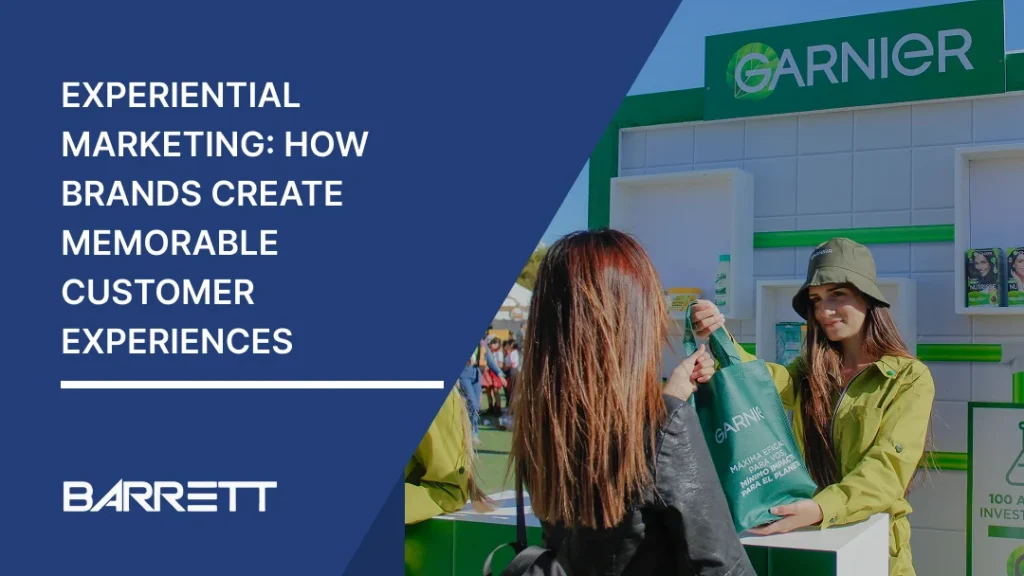
The first step is getting your brand noticed. The next step is ensuring your brand sticks in people’s minds. As people are being exposed to numerous advertisements daily, regular marketing methods might fail to have an effect on them. Brands have to develop new ways to engage people in order to establish connections and generate customer interest.
Experiential marketing allows companies to create experiences where their customers would be able to interact with. However, the creation of experience alone won’t do any good to your brand. In order for your marketing campaign to work, it should be developed according to specific target audience and goals. This guide will help you understand what experiential marketing is and how you can utilize it to create valuable experiences.
What is Experiential Marketing?
Experience marketing is a technique that aims to create direct and firsthand experience between the company and the customers in the form of live events or interactive digital experiences. It is also called experience marketing, engagement marketing, or ground marketing.
For instance, the company selling skincare products might set up a hydration zone at the music event while the automobile company would invite visitors to take a test ride in a customized course. In both cases, the audience will not just see the advertisement but will be able to experience it personally.
Another term for this technique is brand experience and this technique’s main idea should not be just to attract more visitors at your booth. It should help your brand get attention and engage customers in order to move them to the next step.
How Effective Is Experiential Marketing?
The use of experiential marketing works effectively since it results in emotional memory. This technique makes people more likely to remember and trust a brand after physically interacting with it than after simply seeing an ad for it like in a traditional advertisement.
There are several reasons why this kind of marketing can work effectively, including the following:
- Multi-sensory activation: All senses, such as sight, sound, touch, smell, and sometimes even taste, all reinforce the same message at once..
- Social proof through UGC: Participants create pictures or videos of their participation, spreading the idea further through user-generated content.
- Increased intention to buy: Product interaction allows getting rid of any doubts and answering the questions that cannot be answered using traditional advertising.
- Advantage of word-of-mouth marketing: People tend to share their experiences much more often than they share advertisements.
However, this kind of marketing does not always work effectively, and it works depending on the so-called FIT test:
Question | What to check |
Fit | Does the experience support a real campaign goal? |
Interaction | Will people actively participate rather than only look? |
Feasibility | Can the team deliver it safely, accessibly, and consistently? |
Traceability | Can the team connect participation to a measurable next action? |
If a campaign scores poorly on goal fit or feasibility, choose a simpler tactic. Experiential marketing is a poor fit when the only goal is low-cost mass reach, when the audience cannot access the experience, or when there is no realistic way to learn from or follow up with participants.
Experiential Marketing VS Traditional Marketing: Key differences
Traditional marketing broadcasts a message outward. Experiential marketing invites people in. Neither approach replaces the other. Most strong marketing strategies use traditional channels to build awareness and experiential campaigns to deepen the connection.
| Factor | Traditional Marketing | Experiential Marketing |
| Direction of communication | One-way, brand to customer | Two-way, brand with customer |
| Customer role | Passive viewer | Active participant |
| Primary channel | TV, print, digital ads | Live events, pop-ups, installations |
| Emotional impact | Informational or persuasive | Personal and memorable |
| Measurement | Impressions, clicks, reach | Engagement time, UGC, sentiment, leads |
| Shelf life | Short, tied to ad spend | Extended through social sharing |
| Cost structure | Media buy driven | Production and logistics driven |
What are the benefits of Experiential Marketing?
A good experience campaign allows for a brand to:
- Increase awareness: The right experience allows for introducing the brand in an environment that already contains its target audience.
- Help understand products: Product demonstration gives people a chance to see how the product resolves the problem.
- Enhance customer engagement: Being involved in something makes a stronger impression than simply being exposed to it.
- Build emotions: Sensory elements, valuable rewards, and human interactions are all part of building a good experience.
- Generate user-generated content: People attending events generate photos, videos, reviews, or blog posts that carry more trust than any advertising.
- Receive meaningful feedback: It’s easier to collect objections and answer questions during a face-to-face interaction compared to online analytics.
- Convert leads and make sales: Codes, booking pages, trials, free products, and meaningful conversations all allow converting an experience into sales.
- Be different in a competitive market: A memorable experience is harder for competitors to copy than a discount or a slogan.
The most significant drawback is high operational complexity. Events demand venue, permits, staffing, insurance, technology, accessible designs, and even contingencies. Memorable experiences shouldn’t be at the expense of safety or inclusion.
Types of Experiential Marketing
It is important to mention that there are several types of experiential marketing, each one has its own features and applications. Choosing the most suitable type can significantly affect the efficiency of the campaign.
1. Experiential events and exhibitions
Trade shows, exhibitions, and branded events still remain popular among B2B marketers. Exhibition stands, custom booth designs, and demonstrations are great ways to reach the targeted audience in an organized manner. Such formats are good to use to generate quality leads and establish brand reputation in the industry.
2. Brand activations and pop-up experiences
A brand activation involves bringing the brand’s identity to life through temporary experiences such as pop-up shops or events, tastings sessions, mobile activations and guerrilla marketing. Such formats should be chosen if your goal is buzz and discovery of the brand.
3. Interactive and immersive experiences
This type includes interactive installations and immersive experiences. The former allows the audience to become part of the experience while the latter completely immerses them into the atmosphere by means of sound, visuals and design. Brands that have a story to tell choose these formats of experience.
4. Digital and technology-driven experiences
Digital experiential marketing includes digital installations that employ technologies such as LED screens, VR, and AR technologies to provide immersive experience without gathering people in one place. For example, a furniture brand could let its potential clients see how the sofa would look like in their living room through AR.
Effective Strategies to Create an Experiential Marketing Campaign
A memorable experience rarely happens by accident. It follows a structured process. This is how the approach used by experiential marketing teams and agencies looks like.
1. Define Your Target Audience and Campaign Goals
First of all, you should clearly identify who your campaign targets and what it is supposed to do. A campaign can have the goal of brand awareness, lead generation, product trial, and sales. Age, preferences, and behavior of the target audience will affect every further decision related to format, location, and other aspects of your campaign.
2. Choose the Right Experiential Marketing Format
Choosing the right type of Experiential Marketing considering the audience and the goal of your campaign is the key point of successful campaign implementation. For instance, a B2B software company targeting qualified leads will benefit more from a trade show booth than from a street pop-up. A youth fashion brand targeting viral reach will receive more benefits from guerrilla marketing.
3. Design an Experience Around Your Brand
Every visual, interaction, and detail should be related to your brand and reinforce it. Experiential design should be consistent with the colors, tone, and values of the brand, so the experience could become a natural extension of your brand.
4. Encourage Interaction and Participation
Provide people with a clear initial step. Train your team to welcome, explain, listen, and provide leads to other specialists. Make instructions clear. Give options for participation for those who would like to see, try, create something, and speak to an expert. If you use photos, reviews, or other user-generated content, let the participants know where it may be used and ask for permission.
5. Extend the Experience Beyond the Event
It is not enough just to host an event. Encourage user-generated content by providing branded hashtags, photo moments, and shareable takeaways. Develop plans about following up with the audience using email marketing and retargeting, to keep the relationship going after the event ends.
6. Measure Campaign Engagement and Results
Define your criteria of measurement before the campaign begins. Such metrics as:
- Foot traffic or attendance number
- Engagement time on average
- Number and reach of user-generated content
- Number of leads and their conversion
- Mentions and sentiments on social media
- Return on investment compared to the total cost of the campaign
The following formulas can be useful too:
- Attendance rate = attendees ÷ registrants.
- Cost per qualified lead = activation cost ÷ qualified leads.
- Incremental lift = participant result – a suitable comparison result.
- ROI = (incremental gross profit – activation cost) ÷ activation cost.
Without metrics, it is impossible to calculate your ROI and improve your campaign.
Common Experiential Marketing Mistakes to Avoid
The biggest problems even among well-resourced campaigns are usually basic errors. Most of them are not conceptual failures. Instead, they are planning issues that become apparent halfway through the course of the campaign once it gets started. The most common ones are as follows:
- Prioritizing spectacle over brand relevance: An eye-catching event that has no clear connection to the brand entertains people without building recall.
- Skipping audience research: A format that is effective with one demographic may turn out to be a flop with another.
- No plan to capture data or leads: Without a means of collecting data and leads, it will be impossible to evaluate the campaign’s effectiveness.
- Not following up: People are interested in the campaign immediately after experiencing it. Failure to follow up ruins the opportunity.
- Neglecting logistics and costs: Getting permits, planning staff, technology and contingencies can cost more than the actual concept of the campaign.
- Doing it just once: A single activation rarely builds lasting brand loyalty. Consistent, recurring experiences build stronger results over time.
Conclusion
Experiential marketing works because it turns marketing into a lived moment instead of a broadcast message, and brands that pair clear goals with the right format consistently turn that moment into real, trackable brand growth.
Bringing that experience to life still comes down to execution, and this is where Barrett Exhibition Group comes in. With decades of experience designing and building custom exhibition stands and full-scale exhibitions and displays, the team helps brands across Australia turn experiential concepts into physical, on-brand spaces that actually get results.
Frequently Asked Questions (FAQs)
1. What is an example of experiential marketing?
A brand setting up an interactive pop-up experience, such as a beverage company hosting a tasting station with games and branded photo moments at a festival, is a classic example of experiential marketing.
2. What is another name for experiential marketing?
Experiential marketing is also known as experience marketing, engagement marketing, or ground marketing.
3. How much does experiential marketing cost?
In Australia, costs typically range from $2,000 for a small pop-up or sampling activation to $50,000 for a mid-size brand activation, and $80,000 or more for a large custom exhibition stand or multi-city campaign. The budget usually covers design, venue or floor space, staffing, technology, and logistics.
4. What are the five Cs of experiential marketing?
The five Cs commonly referenced in experiential marketing are Concept, Content, Context, Connection, and Community. Together they guide teams to design an idea that fits its setting, delivers meaningful content, and builds a lasting connection within a community of customers.
5. Experiential vs Experimental marketing: Are they the same?
No. Experiential marketing focuses on creating hands-on brand experiences for customers. Experimental marketing refers to testing new, unproven marketing tactics or channels. The similar spelling causes frequent confusion, but the two terms describe different concepts.
Explore Our Other Blogs
Shell Scheme vs Space Only: Which Exhibition Stand Should You Choose?
Choosing between a shell scheme and a space only stand is one..

Exhibition Stand Regulations in Australia: What Every Exhibitor Needs to Know
10 Effective Lead Capture Strategies for Trade Shows and Exhibitions

AusIMM Strategic Mine Planning Conference 2026 in Perth

10 Questions to Ask Custom Stand Builders Before You Hire One
Custom Retail Shop Fit-Out Solutions for Modern Retail Stores
Contact Our Team
Turn your Perth exhibition ideas into unforgettable experiences with Barrett Exhibition Group!
Call us
Call our team to discuss any of our products or services
- 08 9244 2431
Visit us
Chat to us in person at our office
- 18 King Edward Rd, Osborne Park, WA, 6017